1. The Driving Force Behind Mars Exploration
Why invest trillions of dollars and immense effort into colonizing Mars? The push for deep space exploration is driven by three main factors:
-
Human Survival: Becoming multi-planetary acts as an insurance policy against planetary extinction events on Earth.
-
Scientific Discovery: Studying Martian geology, atmosphere, and potential past life gives us deeper insights into Earth's evolution.
-
Technological Innovation: Tackling the extreme challenges of interplanetary travel fuels breakthroughs in clean energy, agriculture, robotics, and recycling technologies on Earth.
2. Who Is Leading the Race to the Red Planet?
The road to Mars is no longer a single nation's journey—it’s a dynamic mix of public space programs and private commercial entities.
SpaceX & Starship
Elon Musk’s SpaceX continues to pioneer fully reusable, super-heavy lift launch vehicles. The SpaceX Starship is designed to carry up to 100 metric tons of payload or crew members directly to orbit, the Moon, and ultimately Mars.
NASA’s Moon to Mars Strategy
Through its Artemis program, NASA is using the Moon as a critical testing ground. By establishing lunar bases and refueling stations, NASA aims to perfect the deep-space technology required before launching crewed missions to Mars.
International Collaborations & Commercial Innovation
Global players and private tech providers are developing specialized rovers, landers, and satellite networks, ensuring that the supply chain for off-world settlements is robust and scalable.
3. Major Challenges of Living on Mars
Setting foot on the Martian surface is only half the battle—surviving there is the true test.
+---------------------+---------------------------------------------------------+
| Challenge           | How Science Is Solving It                               |
+---------------------+---------------------------------------------------------+
| Radiation Exposure  | Subterranean habitats and regolith-shielded domes [1.1.6]|
| Extreme Cold        | Nuclear fission generators and thermal insulation [1.1.5] |
| Thin Atmosphere     | ISRU technology to extract oxygen & fuel [1.1.3, 1.1.5]  |
| Food & Water Supply | Closed-loop hydroponics & mining subsurface ice [1.1.3, 1.1.5]|
+---------------------+---------------------------------------------------------+
1. Extreme Environment and Radiation
Mars lacks a thick atmosphere and a strong magnetic field. Colonists will face cosmic radiation and solar flares. Solution? Building underground habitats or covering structures with Martian soil (regolith) for shielding.
2. In-Situ Resource Utilization (ISRU)
Transporting every drop of water and fuel from Earth is impossible. ISRU technology will allow astronauts to extract water ice from under the surface and generate breathable oxygen and methane fuel using carbon dioxide from the atmosphere via processes like the Sabatier reaction.
3. Psychological and Physical Health
Long-duration spaceflight leads to muscle atrophy, bone density loss, and mental isolation. Advanced artificial gravity concepts, strict exercise regimens, and AI-assisted health monitoring will be vital for astronauts.
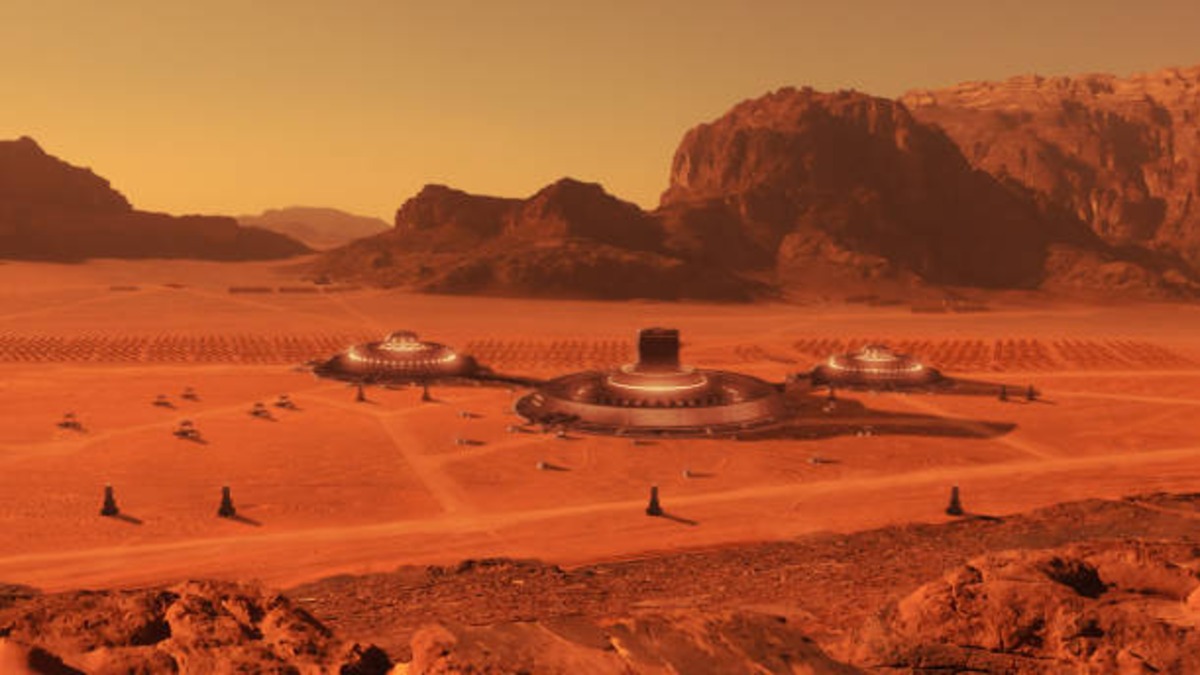
4. Building the First Martian City: What Will It Look Like?
The initial base on Mars will likely start as a small research station similar to Antarctic research outposts, eventually expanding into a self-sustaining habitat:
-
3D-Printed Habitats: Constructed using local regolith to minimize payload from Earth.
-
Vertical Farming & Hydroponics: Growing nutrient-rich crops inside controlled climate domes.
-
Nuclear & Solar Power Grids: Hybrid energy grids designed to withstand massive, planet-wide dust storms.
Conclusion: The Future Is Multi-Planetary
Mars colonization is no longer just a distant dream—it is the logical extension of human curiosity and ambition. As reusable rocket architecture matures and ISRU technologies advance, taking the next giant leap will define the 21st century. The path to becoming an interplanetary species is complex and filled with hurdles, but the destination promises to reshape humanity's future forever.